A 90 kg BMI depends entirely on height. At 4′11″ it reads 40.0 — obesity Class 3. At 6′6″ it reads 23.0 — healthy weight. Same 90 kg, five categories apart. The formula reads only weight and height. Height decides which row the number lands in.
What the number is
BMI is weight in kilograms divided by height in meters squared. For 90 kg at 1.70 m, that is 90 ÷ 2.89 = 31.1. At 1.80 m, it is 90 ÷ 3.24 = 27.8. The formula has no field for muscle, frame, or where the weight sits.
The CDC rows run from underweight below 18.5 up through obesity, which splits into Class 1 at 30–34.9, Class 2 at 35–39.9, and Class 3 at 40 and above. Healthy weight sits between 18.5 and just under 25. Those cutoffs apply to every adult 20 and older, regardless of age, sex, or race.
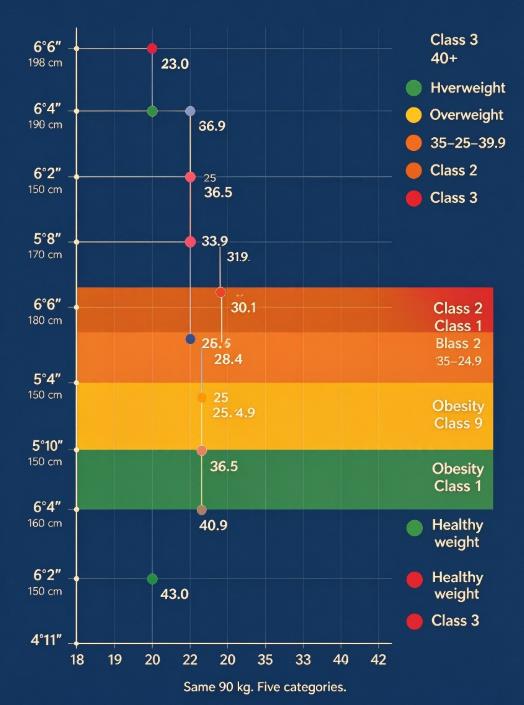
90 kg by height
Every row uses the same weight. The BMI column is calculated, not estimated.
| Height | BMI at 90 kg | CDC category |
|---|---|---|
| 4′11″ (150 cm) | 40.0 | Obesity, Class 3 |
| 5′4″ (163 cm) | 33.9 | Obesity, Class 1 |
| 5′6″ (168 cm) | 31.9 | Obesity, Class 1 |
| 5′8″ (173 cm) | 30.1 | Obesity, Class 1 |
| 5′10″ (178 cm) | 28.4 | Overweight |
| 6′0″ (183 cm) | 26.9 | Overweight |
| 6′2″ (188 cm) | 25.5 | Overweight |
| 6′4″ (193 cm) | 24.2 | Healthy weight |
| 6′6″ (198 cm) | 23.0 | Healthy weight |
BMI calculated as 90 ÷ height in meters squared. Categories per CDC Adult BMI Categories (cdc.gov).
The obesity-to-overweight crossover sits around 5′9″. The overweight-to-healthy crossover sits between 6′2″ and 6′4″. Two adults at 90 kg can land three categories apart on height alone.
Where the number stops explaining
BMI cannot separate lean mass from fat mass. A 90 kg lifter at 5′10″ with 15% body fat and a 32-inch waist prints BMI 28.4. A sedentary 90 kg adult at the same height with 30% body fat and a 40-inch waist prints the same 28.4. The tape is what separates them.
NHLBI draws the added-risk waist line at more than 40 inches for men and more than 35 inches for women. Above those, cardiometabolic risk rises regardless of the BMI row. A body fat calculator adds the fat-versus-lean split the quotient cannot see.
We see this in our own calculator logs. A reader wrote in last spring at 90 kg and 5′11″, BMI 27.9, waist 34 inches, resting heart rate 58. He had been lifting six years. The BMI row said overweight. The tape and the training log said something more specific.
The WHO 2004 expert consultation identified action points at 23.0 and 27.5 kg/m² for Asian populations, below the standard 25 and 30 lines, because metabolic risk appears at lower BMI values in many Asian groups. Many Asian health systems use those lower thresholds. An Asian BMI reference shows both scales together.
How to read your own 90 kg
Run height and weight through a online BMI calculator and note the row. Then add the two measurements the number cannot carry: waist at the navel after a relaxed exhale, and the trend across the last six to twelve months.
If the row and the tape disagree, the tape is more specific. A 90 kg adult at 5′8″ with a 33-inch waist is not in the same risk category as a 90 kg adult at the same height with a 41-inch waist, even though both print 30.1. Tape tension alone can shift a reading nearly an inch on the same morning. Two passes beat one.
All screening framing here stays aligned with the editorial review process led by Dr. Sarah K. Johnson, PhD, RD, consistent with current CDC and WHO publications.
Frequently Asked Questions
What is 90 kg in pounds?
About 198.4 pounds, using 2.20462 as the conversion factor. Most people round to 198 lbs. The conversion does not change the BMI row — a 198 lb adult and a 90 kg adult at the same height land in the same category.
Is 90 kg overweight at 5′6″?
No. At 5′6″ (168 cm), 90 kg reads BMI 31.9, which is obesity Class 1 on the CDC table, not overweight. Overweight requires BMI 25 to under 30, which at 5′6″ corresponds to roughly 70–85 kg.
What height makes 90 kg a healthy weight?
Roughly 6′4″ (193 cm) or taller lands inside the CDC healthy band. The crossover is narrow:
6′2″ (188 cm): 25.5 — overweight.
6′3″ (191 cm): 24.7 — healthy weight.
6′4″ (193 cm): 24.2 — healthy weight.
6′6″ (198 cm): 23.0 — healthy weight.
Below 6′3″, 90 kg lands in overweight or obesity on the standard table.
Does 90 kg mean the same for a muscular adult?
No. A trained adult at 90 kg can carry 15% body fat and a 32-inch waist, reading the same BMI as a sedentary adult with 30% body fat and a 40-inch waist. Waist and body-fat percentage are the relevant screens for trained bodies.
What waist thresholds should a 90 kg adult track?
NHLBI sets the added-risk line at more than 40 inches (102 cm) for men and more than 35 inches (88 cm) for women. For Asian populations, many health systems use lower cutoffs. Waist-to-height ratio adds a scalable check: keep the waist under half your height.
Sources
CDC: Adult BMI Categories — Standard Thresholds for Adults 20 and Older
NHLBI: Overweight and Obesity — Waist Circumference Thresholds
This article is for informational and educational purposes only. It does not constitute medical advice or replace professional health assessment. Always consult a qualified healthcare provider regarding your individual health and weight-related goals. Individual results will vary. The BMI Calculator Blog Team maintains editorial independence and does not sell health products.