At a Glance: A reliable BMI calculator that supports both metric and imperial units eliminates conversion errors and makes tracking your health effortless, whether you use kilograms and meters or pounds and inches. This guide walks through how to measure yourself accurately, switch between units seamlessly, interpret your results with context, and understand what your BMI can and cannot tell you. All guidance follows WHO and CDC standards for adult weight assessment.
Editorial development: BMI Calculator Blog Team — reviewed by in-house public health analysts and certified nutrition professionals, including a Registered Dietitian Nutritionist (RDN). Content fully aligned with WHO and CDC clinical guidelines for adult weight assessment. Last Reviewed: May 2026.
Why a Dual-Unit BMI Calculator Makes Health Tracking Easier
Navigating health metrics can feel like a chore when you're switching between measurement systems. Most of us have been there—staring at a scale that reads in kilograms when you're used to pounds, or trying to remember whether 175 centimeters translates to a healthy weight in a formula built for inches. A reliable BMI calculator that supports both metric and imperial units removes that friction entirely, letting you focus on what the number actually means for your health. Imagine a traveler who packs a smart scale into a carry-on, steps onto it in a Paris hotel room, and sees his weight in kilograms—no mental math, no squinting at conversion tables on his phone, just a number he trusts because the calculator toggled to metric the moment he opened it.
BMI, short for Body Mass Index, is the screening tool recommended by the Centers for Disease Control and Prevention (CDC) and the World Health Organization (WHO) to quickly assess weight-related health risks in adults. It's a simple ratio of weight to height, but its usefulness depends on getting the numbers right. Manually converting pounds to kilograms or inches to meters introduces errors that can shift your BMI by a full point or more—enough to flip your category. A dual-unit calculator handles those conversions instantly, so your results stay accurate no matter which system you use.
Ready to calculate your BMI accurately?
Use our free, dual-unit BMI Calculator that automatically handles metric and imperial conversions for error-free results.
How to Use a BMI Calculator That Supports Both Units
Using a dual-unit BMI calculator is straightforward, but a few small habits make the difference between a reading you can trust and one that misleads. Here's how to get consistent, reliable results every time.
Step 1: Measure Yourself the Right Way
You need two numbers: your weight and your height. For metric, use kilograms and centimeters. For imperial, use pounds and inches. Most digital scales today have a toggle to switch between kg and lbs.
Measure your height barefoot, standing straight against a wall with your heels together and your head level. Use a hard object like a book to mark the top of your head, then measure from the floor to that mark. Pro Tip from our health team: For the most consistent height measurement, have a friend mark the wall with a pencil while you stand straight, looking ahead—self-measuring height is notoriously inaccurate. For weight, step on the scale first thing in the morning, before eating or drinking, wearing light clothing. This consistency ensures your BMI results are comparable over time.
Step 2: Choose Your Unit System
Open your dual-unit BMI calculator and select the unit toggle—usually labeled Metric or Imperial at the top of the tool. If you pick the wrong one, most good calculators let you switch without retyping your numbers.
Step 3: Input Your Numbers Carefully
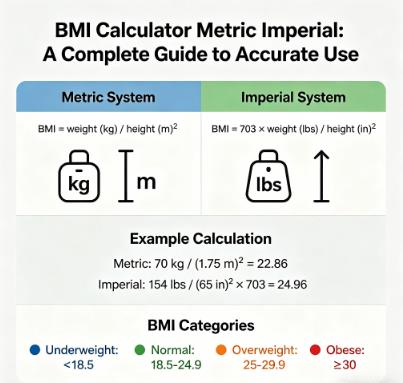
Enter your weight and height in the unit system you selected. The calculator handles the math—for metric, it converts centimeters to meters and applies the formula (weight in kg divided by height in meters squared). For imperial, it applies the conversion factor (weight in lbs divided by height in inches squared, multiplied by 703).
Double-check your inputs before calculating. A small typo—entering 170 cm instead of 175 cm, a 5 cm difference—can shift your BMI by nearly a full point, moving you between weight categories. Take an extra second to confirm your numbers.
Step 4: Interpret Your Results With Context
Once you calculate, the tool shows your BMI number and its corresponding category. The WHO and CDC use standard categories for adults: underweight (below 18.5), healthy weight (18.5–24.9), overweight (25.0–29.9), and obese (30.0 and above). These categories are globally recognized screening guidelines—not one-size-fits-all verdicts.
Factors like muscle mass, age, gender, and ethnicity all affect what a healthy BMI looks like for you. A bodybuilder with high muscle mass might register as overweight with low body fat. Someone with low muscle mass might show a normal BMI while carrying a higher body fat percentage. For a more complete picture, pair your BMI with a body fat calculator that estimates composition from circumference measurements.
Finding Your Healthy Weight Range
Once you have your BMI, you can use it to find your healthy weight range—the range of weights that fall within the healthy BMI category (18.5–24.9) for your height. Most dual-unit BMI calculators show this range automatically, but knowing how it works helps you set realistic goals.
For metric: Convert your height to meters (divide cm by 100). Square that number. Multiply by 18.5 for the lower end and by 24.9 for the upper end. For example, at 175 cm (1.75 m): 1.75 × 1.75 = 3.0625. Then 3.0625 × 18.5 ≈ 56.7 kg, and 3.0625 × 24.9 ≈ 76.3 kg. Your healthy weight range is roughly 56.7 to 76.3 kg.
For imperial: Square your height in inches. Multiply by 18.5 and 24.9, then divide each result by 703. For example, at 68 inches: 68 × 68 = 4624. Then 4624 × 18.5 ÷ 703 ≈ 122 lbs, and 4624 × 24.9 ÷ 703 ≈ 164 lbs.
This range is a guideline, not a target. Your healthiest weight depends on your body composition, age, and overall health—not just a number on the chart.
What Your BMI Doesn't Tell You
While a dual-unit BMI calculator is a useful starting point, BMI has known limitations. It doesn't distinguish between muscle, fat, bone, or water weight. Athletes or people with high muscle mass often have a higher BMI despite low body fat. According to the American College of Sports Medicine (ACSM), body fat percentage is a far more meaningful metric for active populations, and BMI should be paired with body composition testing whenever possible. Seniors, who experience age-related muscle loss (sarcopenia), may have a normal BMI while carrying excess body fat and being at risk for malnutrition.
The WHO also notes that Asian populations often face elevated health risks at lower BMI thresholds—overweight beginning at 23 rather than 25, and obesity at 25 rather than 30—due to differences in body composition and fat distribution. A 2004 WHO expert consultation published in The Lancet formally recommended these adjusted thresholds after finding that for every unit of BMI above 22.0, the risk of type 2 diabetes increased more steeply in Asian populations than in white populations. An Asian BMI calculator that applies these ethnic-specific thresholds provides a more accurate risk picture. A 40-year-old professional in Singapore, using a standard dual-unit calculator, could see a BMI of 23.5 and be told she's in the clear—when under Asian-specific guidelines she's already crossed into a range that warrants preventive action.
Gender differences matter too. Women naturally carry a higher body fat percentage than men at the same BMI, while men tend to have more muscle mass. A gender-adjusted BMI calculator accounts for these physiological differences, providing more personalized context for your results.
Tips for Consistent, Accurate Results
Measure at the same time each day. Morning, after using the bathroom and before eating or drinking, gives the most consistent readings. Daily weight fluctuations of 1–2 kg (2–4 lbs) are normal and usually reflect water retention, not fat gain.
Use reliable equipment. A quality digital scale on a hard, flat surface provides more accurate readings than an analog scale on carpet. For height, use a rigid measuring tape—not a flexible fabric one—and have someone help if possible.
Track trends, not single readings. A single BMI measurement is less informative than watching how your number changes over months. A gradual, sustained shift tells you more than any isolated reading.
Use BMI as a starting point, not a final diagnosis. If your BMI falls outside the healthy range, discuss it with a healthcare provider who can interpret the number alongside your medical history, lifestyle, and other health metrics.
Here are answers to some common questions we get about using a BMI calculator with different units.
Content Integrity Review: The health information and BMI classification standards in this article have been checked for alignment with current WHO and CDC guidelines on adult weight assessment. Individual medical advice should always be obtained from your personal healthcare provider.
Prepared based on WHO global BMI standards, CDC clinical guidelines, ACSM body composition recommendations, and peer-reviewed body composition research.
Sources
Frequently Asked Questions
What's the difference between metric and imperial BMI formulas?
The metric formula divides weight in kilograms by height in meters squared (kg/m²). The imperial formula divides weight in pounds by height in inches squared, then multiplies the result by 703. While the math differs, both formulas produce the same BMI number when the measurements are equivalent. A dual-unit calculator handles the conversion automatically.
Can I switch between metric and imperial units in the same calculation?
No. You must use either all metric (kg and cm) or all imperial (lbs and inches) units for a single calculation. Mixing units—such as entering weight in pounds and height in centimeters—produces an incorrect result. A dual-unit calculator prevents this by toggling the entire input system at once.
Is there any risk of mixing metric and imperial BMI inputs?
Yes. The most common error occurs when someone enters weight in pounds but height in centimeters, or weight in kilograms but height in inches. Because the two formulas use different constants—the imperial formula multiplies by 703—mixing units produces a BMI number that can be off by 10 points or more. A dual-unit calculator that forces a single system selection eliminates this risk. If you ever need to verify your result manually, run the numbers through the correct formula for the unit system you used.
Does using a dual-unit BMI calculator affect accuracy for Asian adults?
The calculation itself is unaffected by unit choice—a BMI of 23 is 23 whether you used metric or imperial inputs. However, standard BMI calculators apply the same category thresholds regardless of ethnicity. For Asian adults, the WHO recommends lower thresholds: overweight begins at 23 rather than 25, and obesity at 25 rather than 30. A dual-unit calculator that doesn't adjust for ethnicity will classify an Asian adult with a BMI of 24 as normal weight, when in fact they may already be at elevated metabolic risk. For the most accurate assessment, use an ethnicity-specific calculator that applies these adjusted ranges.
Why does morning measurement give the most reliable BMI results?
Morning measurements—after using the bathroom and before eating or drinking—provide the most consistent baseline because they eliminate the variables that cause weight to fluctuate throughout the day. Food, water, sodium intake, and physical activity all temporarily shift your weight by 1–2 kg (2–4 lbs). Measuring under the same fasting conditions each time ensures that changes you see over weeks and months reflect actual body composition trends, not daily noise.
How often should I check my BMI?
Once or twice a year is sufficient for most adults, or whenever your weight changes by 10 pounds or more. Tracking trends over time is more valuable than frequent checks, as daily fluctuations in weight are normal and don't reflect meaningful body composition changes.
BMI Calculator Blog. This content is provided for educational and informational purposes only. We encourage sharing with proper attribution to our site. Unauthorized commercial use is prohibited. Medical Disclaimer: The content of this article is for informational purposes only and does not replace professional medical advice, diagnosis, or treatment. Always seek the advice of a qualified physician or other health experts with any questions regarding medical conditions or health goals.