BMI accuracy for seniors means adjusting for age-related changes — height loss from spinal compression (1–3 inches by age 80), muscle loss of 3–5% per decade after 60, and a higher healthy BMI range of 23–28. Generic tools don't account for these shifts. Use a senior-specific calculator, measure your current height annually, and pair BMI with waist circumference for a complete picture.
From the thousands of seniors we've helped, the most common confusion isn't about the BMI number itself — it's why the "healthy" range feels wrong. Often, the problem starts with an old driver's license height that hasn't been updated in 20 years. Let's walk through the fixes that actually make a difference.
Why Senior BMI Accuracy Is Different
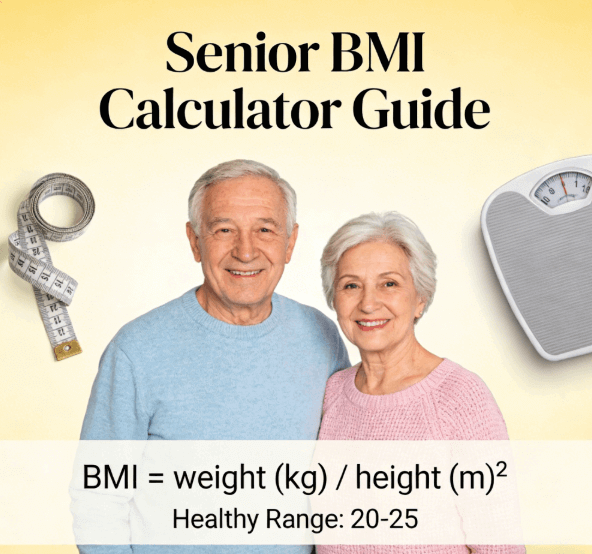
The standard formula doesn't change: weight in kilograms divided by height in meters squared (kg/m²), or (weight in pounds divided by height in inches squared) × 703. But everything around that formula — which height you use, what "healthy" really means for a 75-year-old — shifts as you age.
The CDC classifies adult BMI into four standard categories: underweight (below 18.5), healthy weight (18.5–24.9), overweight (25.0–29.9), and obesity (30.0 and above). Yet Winter and colleagues (2014), in a meta-analysis of 32 studies covering nearly 200,000 adults aged 65 and older, found that mortality risk didn't increase in the overweight range; instead, risk went up below 23.0. For older adults, a BMI of 23–28 is linked with the lowest mortality. If you're 75 and your BMI is 26, you might actually be in the sweet spot — even though a generic chart labels you "overweight."
What Actually Moves the Needle on Accuracy
Generic adult BMI tools use 18.5–24.9 as the healthy range — a window built from data on younger and middle-aged adults. For someone over 65, that window is often wrong. A senior-specific calculator uses the 23–28 range supported by geriatric research, acknowledging that a slightly higher BMI protects against falls, malnutrition, and frailty.
I've heard from countless families about a 78-year-old who used a standard tool, got 26.5 ("overweight"), cut calories for months, lost muscle mass, and felt weaker. When he switched to a senior BMI calculator, the same number fell into the healthy range. His BMI reading stayed exactly the same; only the context for reading that number shifted.
Getting Height and Weight Right
Height loss is a quiet, gradual part of aging. By age 80, most adults have lost 1–3 inches (2.5–7.6 cm) due to spinal disc compression, osteoporosis-related fractures, and postural shifts. Using a decades-old height inflates your BMI, making you seem heavier for your height than you really are. We frequently run into this measurement error with older adults completing self-guided home assessments.
Self-measuring almost always leads to slouching, so get help and stand against a hard wall. Stand barefoot with heels together and back flat; have a friend mark the top of your head with a pencil; measure from floor to mark with a rigid metal tape (fabric tapes stretch). Recheck every 1–2 years because height loss is ongoing.
Weight swings in older adults can be just as misleading. Medications like blood pressure pills or diuretics shift water balance. A mild illness can suppress appetite. Weigh first thing in the morning, after using the bathroom, before eating or drinking. Wear the same light clothing each time, and place the scale on a hard floor — carpet adds 1–3 pounds of error. If you've just started a new medication or are recovering from an illness, wait 2–3 weeks until your weight stabilizes.
Look Beyond the Scale
After 60, adults lose 3–5% of muscle mass per decade. That's sarcopenia, and BMI can't see it. Someone at 75 with a "healthy" BMI of 24 may actually carry high body fat and low muscle — a pattern that standard BMI completely misses. Pair your BMI with a body fat calculator that factors in waist, age, and gender. For older men, a healthy body fat range is 20–30%; for older women, 25–35%. If your body fat exceeds these levels while your BMI is "normal," prioritize muscle-building activity — chair exercises, walking with light weights — not calorie cutting.
Abdominal fat is a stronger predictor of heart disease and diabetes in seniors than BMI alone. Wrap a flexible tape around your bare abdomen at navel level, parallel to the floor. Don't suck in, and measure at the end of a normal exhale. For men, a waist above 40 inches (102 cm) signals elevated risk; for women, above 35 inches (89 cm).
When to Pause BMI Tracking
BMI is only useful when your body is in a steady state. Temporary health events — fluid retention from kidney issues, an infection, surgery recovery — cause weight changes that don't reflect your true body composition. Don't calculate BMI during these periods. Wait until your weight has held steady for 2–3 weeks.
Why Accuracy Matters: Real Consequences of a Misleading Number
A 2019 study in the Journals of Gerontology found that older adults misclassified as "overweight" by BMI were significantly more likely to restrict calories unnecessarily, accelerating sarcopenia and increasing fall risk over three years. These misread BMI numbers show up in real-world senior care, and they can bring avoidable health risks. A falsely low BMI can hide undernutrition, which doubles infection risk. Accurate readings allow trends to tell the true story: a gradual rise from 22 to 25 over several years is often normal and protective; a sudden jump from 24 to 28 in three months demands attention.
When to Bring Your BMI to Your Healthcare Provider
BMI is a conversation starter. Think of it as the thing you bring to the appointment, not the conclusion your doctor reaches. Bring your trend data to your next visit if any of these apply:
Unintentional weight loss. If your BMI is dropping but your eating is normal, a decline of 2+ BMI points over 6 months without diet changes should be evaluated.
A growing waist with a stable BMI. This pattern suggests visceral fat gain and muscle loss — a combination that BMI alone misses.
A sudden jump of 2+ points in under 3 months. Rapid gains may signal fluid retention from medications, heart issues, or kidney changes, not actual fat gain.
A shift that doesn't match your lifestyle. Any abrupt change after years of stability is a signal to check in with your provider.
Frequently Asked Questions
What is the correct BMI for someone over 65?
Research supports a healthy range of 23–28. Winter and colleagues (2014) found higher mortality below 23 and above 33 in this age group. The standard 18.5–24.9 may be too low for many older adults, since a slightly higher BMI provides protective reserve against frailty and illness.
Why does my BMI change when I use my old height versus my current height?
Height is squared in the formula. Losing 2 inches — common between 50 and 80 — can shift your BMI up by 1–2 points. Always use a recent measurement taken against a hard wall with a rigid tape, ideally with help from another person.
Should seniors aim for a lower BMI to be healthier?
Not necessarily. Intentional weight loss should be approached cautiously and never based on BMI alone. A slightly higher BMI can provide a protective reserve against frailty and illness. Prioritize muscle strength and functional independence over a number on the scale.
How often should a senior check their BMI?
Every 2–3 months is plenty. Meaningful body composition changes take time. Follow these guidelines to keep tracking useful rather than stressful:
Track trends, not single readings. Quarterly measurements alongside waist circumference reveal direction without anxiety over normal daily fluctuations.
Measure under the same conditions each time. Morning, after voiding, before food, light clothing, hard floor.
Log both BMI and waist circumference together. A stable BMI with a shrinking waist is often a sign of muscle gain and fat loss working in your favor.
Sources
CDC NHANES: Anthropometry Procedures Manual — Standardized Height and Weight Measurement
Winter JE, MacInnis RJ, Wattanapenpaiboon N, Nowson CA. BMI and all-cause mortality in older adults: a meta-analysis. Am J Clin Nutr. 2014;99(4):875-890. DOI
This article is for informational and educational purposes only. It does not replace professional medical advice. Consider discussing your results with a qualified healthcare provider. The BMI Calculator Blog Team maintains editorial independence and does not sell health products.