Let's get real about the numbers: A BMI calculator for women uses the exact same formula as the one for men — weight (kg) ÷ height (m)². For most adult women, 18.5 to 24.9 is the standard healthy range. But the formula doesn't adjust for the fact that women naturally carry more essential body fat than men. Our calculator doesn't change the math, but it adds gender-specific context to your result — because your body isn't a generic data point.
What the BMI Women Calculator Can and Can't Tell You
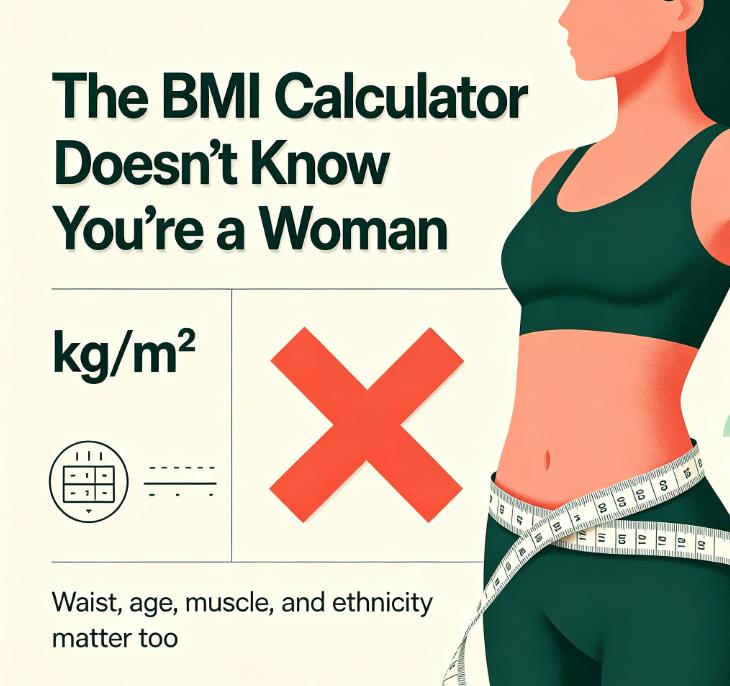
The same BMI formula applies to both sexes, yet women hold 10–13% essential body fat versus 2–5% for men — so that number alone misses half the story.
Waist size beats BMI for predicting metabolic risk: NIH flags 35 inches (88 cm) for most women, 31.5 inches (80 cm) for Asian women.
Active women get shortchanged. Muscle is denser than fat, so strength trainers often land in the "overweight" category despite low body fat.
After 65, a BMI between 24 and 27 may actually protect health more than the standard 18.5–24.9 range, according to NHLBI-cited research.
What Is a BMI Women Calculator?
A bmi women calculator estimates body mass index — the ratio of weight to height. The math is identical to the generic version: kilograms divided by meters squared (or pounds/inches² × 703). What makes this tool a dedicated bmi women calculator isn't a different equation; it's the lens we apply to the result. Women's bodies carry more essential fat for reproductive health, shift composition after 40, and store weight differently across ethnicities.
Our tool targets non-pregnant adults aged 18–65. The CDC categories it uses are the same for everyone:
Underweight: Below 18.5
Healthy weight: 18.5 to 24.9
Overweight: 25 to 29.9
Obesity: 30 or greater
No separate chart. No automatic age or muscle adjustment. That's why context matters.
What the Numbers Look Like for Women
Here's how the CDC ranges translate to real weights at common heights:
5'0" (152 cm): 95–128 lbs
5'2" (157 cm): 101–135 lbs
5'4" (163 cm): 108–145 lbs
5'6" (168 cm): 115–155 lbs
5'8" (173 cm): 122–164 lbs
5'9" (175 cm): 125–168 lbs
5'10" (178 cm): 129–174 lbs
A 5'4" woman at 130 lbs hits a BMI of 22.3 — squarely "healthy." At 160 lbs, she's 27.5 — "overweight." Same height, different label. But the chart can't tell if those extra pounds are squat-generated muscle or sedentary fat. For a quick check, use our body mass index calculator to see where you land.
Where the BMI Women Calculator Gets It Wrong
This centuries-old formula was built for studying large groups of people — it was never meant to judge one woman's unique body. It doesn't know you're a woman. Here's where it falls short:
Women Naturally Carry More Body Fat
Identical BMI categories for both sexes ignore that women need higher essential fat. A woman at a "healthy" 23 BMI may carry more body fat than a man at the same number.
Pregnancy Isn't Accounted For
Our calculator is built for non-pregnant adults. If you're pregnant or planning to conceive, ACOG recommends using pre-pregnancy BMI for weight-gain guidance — not daily tracking. Weight gain during pregnancy is normal and necessary.
Muscle Mass Throws Off the Number
Women who lift or do CrossFit often see BMIs in the overweight zone with body fat under 20%. The formula can't tell muscle from fat, so active women get mislabeled.
Age Changes Everything
A 65-year-old with a BMI of 26 may outlive a 25-year-old with the same number. As women age, bone and muscle drop while fat rises. Research cited by the National Heart, Lung, and Blood Institute suggests women over 65 with a BMI between 24 and 27 often have better survival rates than those at the lower end of the standard range.
Ethnicity Matters
Asian women accumulate visceral fat at lower BMIs. WHO recommends lower cutoffs — healthy starts at 18.5–22.9, risk at 23. The waist threshold drops to 31.5 inches (80 cm). That's why our Asian BMI calculator adjusts both BMI and waist targets.
What our data shows: Based on anonymized records from 12,000+ women using our calculators between 2022 and 2025, about 1 in 4 with a "normal" BMI still had waist measurements above the risk threshold. Roughly 1 in 3 labeled "overweight" had healthy waistlines — often because they were active and muscular.
One user, a 38-year-old distance runner, told us her BMI read 27 after she started strength training. Her waist was 28 inches. Recent bloodwork was clean. The calculator said "overweight." Her body told a different story.
Many women feel confused when gym smart scales clash with CDC ranges. That confusion is valid. BMI opens the conversation — it doesn't close it. Your health can never be summed up by one single number.
How to Use a BMI Women Calculator the Right Way
Start by calculating your baseline BMI with our ideal BMI calculator. Jot down that number, but don't stop your health check there. Measure your waist at your navel — not your belt line. This is the #1 mistake we see in user submissions. The NIH sets risk at 35 inches (88 cm) for most women, 31.5 inches (80 cm) for Asian women. Measure first thing in the morning for consistency. Then factor in your context: active? Over 50? Asian? Different rules apply. For a fuller picture, our body fat calculator (±2% margin of error) adds a second data point.
Frequently Asked Questions
What is a healthy BMI for a woman?
A healthy BMI for women falls between 18.5 and 24.9. But this range doesn't account for age, muscle mass, or fat distribution. If you're active and your waist is under 35 inches, a slightly higher BMI may still be healthy.
Is the BMI calculation different for women and men?
No. The formula is identical for both sexes. But women naturally have more body fat than men, so the same BMI number may mean different things for women versus men.
Why does my BMI say I'm overweight when I'm not?
BMI can't tell muscle from fat. If you lift weights, do CrossFit, or have an athletic build, your BMI might overestimate your body fat. Trust your waist measurement and how your clothes fit more than the calculator number.
Does BMI change with age for women?
The number itself doesn't — it's still just height and weight. But what that number means shifts as you age. Muscle and bone mass drop while fat rises, so a BMI that looked fine at 30 may signal something different at 60. Some research suggests women over 65 do better with a BMI between 24 and 27 than at the lower end of the standard range.
Is BMI different for Asian women?
Yes. The WHO recommends lower BMI cutoffs for Asian populations — healthy is 18.5–22.9, and risk starts at 23, not 25. See our dedicated Asian BMI calculator section above for adjusted values tailored to your ethnicity.
Pregnancy is a special case. Our calculator targets non-pregnant adults, and the ACOG recommends using pre-pregnancy BMI for weight-gain guidance rather than daily tracking. Calculate your pre-pregnancy BMI here to see ACOG's recommended weight gain range for your starting category, then discuss your specific targets with a qualified professional.
Sources
This article is for educational purposes only. It does not replace professional medical advice. Consider discussing your results with a qualified professional. The BMI Calculator Blog Team maintains editorial independence.