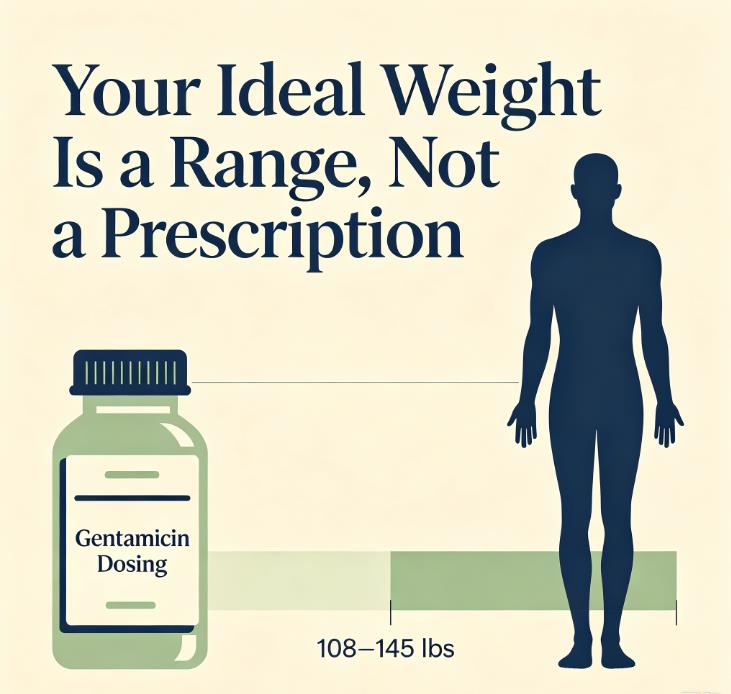
Ideal body weight is a range, not a number — and the formulas that claim to give you one were built for drug dosing, not for health. For a 5′4″ woman, the healthy BMI band runs roughly 108–145 lbs. Devine and Hamwi land near 120 lbs; Robinson and Miller push into the 120s. None of them is right.
The spread exists because each equation answered a different institutional question — drug dosing, quick clinical estimates, insurance tables. No one mis-added.
What “ideal body weight” actually means
IBW is a height-based estimate. The CDC defines healthy weight as a BMI of 18.5 to under 25 for adults 20 and older, regardless of age, sex, or race. For a 5′4″ adult, that band translates to roughly 108–145 lbs. A 37-pound window.
The CDC is explicit that BMI is a screening measure and “should be considered with other factors when assessing an individual’s health.” That sentence matters more than the cutoff table. It means the band is a starting point, not a verdict, and it means a single formula output cannot substitute for the band.
Why the formulas disagree — and what they were built to do
Walk into a U.S. hospital pharmacy and you will find Devine on a dosing worksheet. That is what the equation was for. A 2000 review in the Annals of Pharmacotherapy traced the lineage: height-weight tables were built to compare populations, those tables correlated with mortality, and the word “ideal” attached itself to the middle of the distribution. Devine’s equation entered clinical use because the pharmacokinetics of certain drugs correlated with IBW — not because it described an optimal body.
| Formula | Year | 5′4″ female | Original context |
|---|---|---|---|
| Hamwi | 1964 | ~120 lb | Quick clinical estimate |
| Devine | 1974 | ~120 lb | Drug dosing (gentamicin) |
| Robinson | 1983 | ~123 lb | Drug dosage calculations |
| Miller | 1983 | ~129 lb | Refined clinical estimate |
Nine pounds between the lowest and highest output for the same height. None of those four numbers accounts for muscle, frame, or fat distribution. The formulas still appear in dosing worksheets because that is what they were built for. They were never personal prescriptions.
Where the range moves: waist, age, and ethnicity
The 18.5–24.9 band is a baseline. Three adjustments change the picture for large groups of adults.
Waist circumference cuts across everything else. Most people measure their waist once, then never again. NHLBI draws the risk line at more than 35 inches for women and more than 40 inches for men. A 5′4″ woman at 140 lbs with a 33-inch waist and a 5′4″ woman at 125 lbs with a 37-inch waist are not in the same risk category, even though both sit inside the BMI window. The tape measures where fat sits. BMI measures how much mass the body carries.
Age bends the mortality curve upward. Winter and colleagues pooled 32 prospective cohorts covering 197,940 adults aged 65 and older. Using BMI 23.0–23.9 as the reference, mortality risk was 12% higher at BMI 21.0–21.9 and 19% higher at BMI 20.0–20.9. Being in the 25–30 band was not associated with increased mortality in this older group. Risk rose again above BMI 33.0. A BMI reading of 21 for a 75-year-old does not carry the same interpretation. That same number is more reassuring for a 35-year-old adult.
Ethnicity shifts the action points. The WHO 2004 expert consultation identified further public health action points at 23.0, 27.5, 32.5, and 37.5 kg/m² for Asian populations. The reason: the proportion at high risk of type 2 diabetes and cardiovascular disease is substantial at BMIs below the standard overweight line of 25. The consultation did not redefine “overweight” for every Asian population — it proposed action points along the continuum. A BMI of 24 that reads “normal” on the global table may already warrant a closer look in some Asian groups.
How to use the range without chasing a number
Start with your height in the BMI band. Then add the measurements that decide whether a point inside it fits your body.
Measure your waist first. It takes ten seconds and tells you more about visceral fat than the scale does. If your waist is under the threshold and your weight sits inside the band, you are in reasonable territory. If your waist is over the threshold and your BMI reads “healthy,” the waist is the signal worth reviewing. A body composition estimator adds the tissue-level layer if you want the fat-versus-lean breakdown.
Check your baseline with a free BMI screening tool. For age-adjusted context, an age-adjusted BMI checker can place the same number against older-adult bands. Neither tool replaces the tape.
From anonymized sessions of women using our tools, most 5′4″ users report feeling healthiest between 118 and 135 lbs — inside the CDC band, not pinned to a 1964 chart. One reader tracked for six months: her weight moved less than three pounds, but her waist dropped two inches. The scale said nothing had changed. The tape said otherwise.
Pick a target you can hold through a holiday season and a stressful month, not one you hit once and lose by spring.
Frequently Asked Questions
What is the ideal body weight for my height?
It depends on the frame you use. For a 5′4″ woman, the formulas land between 120 and 129 lbs. The CDC healthy BMI range is 108–145 lbs. The range is the more useful starting point because it does not pretend one point inside it is correct.
Why do different ideal body weight formulas give different numbers?
Because they were derived from different data for different purposes. Hamwi was a quick clinical estimate. Devine was built for gentamicin dosing. Robinson and Miller refined the math but kept the clinical orientation. The coefficients differ because the underlying samples and goals differ, not because one is more “accurate” for health.
Does ideal body weight change with age?
Yes, and the shift is measurable. Winter et al’s 32-cohort meta-analysis found that for adults 65 and older, the reference band was BMI 23.0–23.9. Compared with that reference:
BMI 21.0–21.9 carried a 12% higher mortality risk.
BMI 20.0–20.9 carried a 19% higher risk.
BMI 25–30 was not associated with increased mortality in this group.
Risk rose again above BMI 33.0.
In other words, the lowest-risk zone in that age group sits higher than the standard 18.5–24.9 band.
Is BMI or ideal body weight better for athletes?
Neither. Both miss muscle. A lifter at 5′9″ and 190 lbs with 12% body fat reads BMI 28 — overweight — while a sedentary adult at 160 lbs with 30% body fat reads “healthy.” Body fat percentage and waist circumference are the more relevant screens for trained bodies.
Should I use ideal body weight as my goal?
Treat it as a rough reference from a clinical context, not a target. Waist circumference, stable weight across seasons, and strength matter more than hitting 120 lbs on the dot. If the formula and the tape disagree, the tape usually has the more useful answer.
Sources
CDC: Adult BMI Categories — Healthy Weight 18.5 to Under 25 and Screening Guidance
NHLBI: Overweight and Obesity — Waist Circumference Thresholds and Health Risk
This article is for informational and educational purposes only. It does not constitute medical advice or replace professional health assessment. Always consult a qualified healthcare provider regarding your individual health and weight-related goals. Individual results will vary. The BMI Calculator Blog Team maintains editorial independence and does not sell health products.
Related Articles
What Is My Ideal Body Weight? A Complete Guide to Finding Your Healthy Range
Your Ideal Body Weight Is a Range, Not a Number: What Formulas Miss and What to Track
What Is Ideal Body Weight? Why Formulas Give Different Numbers
Last updated: October 18, 2026.