Let's get one thing straight: Body fat percentage is the amount of fat you carry relative to everything else — muscle, bone, organs, water. Reducing it isn't about starving yourself or spending hours on a treadmill. It's about three things: moving the right way, eating smart, and managing stress and sleep. This guide gives you the science-backed playbook — no gimmicks, no extremes, just what actually works.
Developed by BMI Calculator Web Editorial Team, reviewed alongside our in-house RD team in line with CDC, ACE, and NIH body composition standards.
What Is Body Fat Percentage — and Why Does It Matter?
Body fat percentage is exactly what it sounds like: the proportion of your total weight that comes from fat. Not to be confused with BMI, which just looks at height and weight. Two people can have the same BMI and completely different body fat levels — one ripped, one not.
According to the American Council on Exercise (ACE), here's what healthy looks like:
Women: Essential fat 10–13% | Athletes 14–20% | Fitness 21–24% | Acceptable 25–31%
Men: Essential fat 2–5% | Athletes 6–13% | Fitness 14–17% | Acceptable 18–24%
These standardized ACE ranges help you contextualize your body fat level far better than BMI alone, accounting for natural gender differences in body composition.
Why does this number matter more than your weight? Because excess body fat — especially the kind stored around your organs (visceral fat) — is directly linked to high blood pressure, heart disease, diabetes, and even certain cancers. Even if your BMI looks normal, too much belly fat still puts you at risk.
How to Reduce Body Fat: The Three-Legged Stool
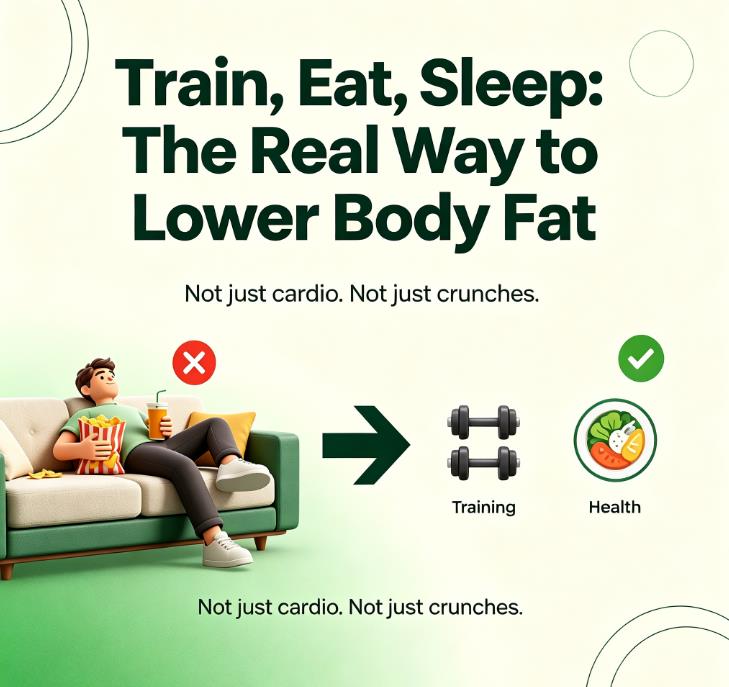
Sustainable fat loss relies on consistent habits, not quick fixes. It comes from three equally important pieces:
Exercise — the right mix of cardio and resistance training
Nutrition — what you eat, when you eat it, and how much
Recovery — sleep and stress management (this one gets ignored way too often)
Neglect any single piece, and fat-loss progress becomes far harder to sustain.
Exercise: What Actually Works for Fat Loss
Let's be honest — most people get this backwards. They either do only cardio or only lift weights. The science says you need both — but the balance depends on your goals.
Research shows that all exercise types — aerobic, high-intensity interval training (HIIT), and resistance training — reduce body fat percentage and waist-to-hip ratio significantly compared to diet alone. But here's where they differ:
For maximum fat loss: Vigorous aerobic exercise is the most effective for reducing body fat percentage. Think running, cycling, swimming at a pace that makes you breathe hard.
For preserving muscle while losing fat: Resistance training is non-negotiable. If you only do cardio, you'll lose muscle along with fat — which slows your metabolism over time.
For visceral belly fat specifically: High-intensity exercise appears to be more effective than low-to-moderate intensity for reducing that dangerous deep belly fat.
The data points to one clear takeaway: combining resistance training with aerobic exercise is the most effective way to improve not just weight, but how much and where fat is stored in the body. Harvard experts recommend 30 to 60 minutes of moderate-intensity cardio three or more days a week, plus regular resistance training.
Based on anonymized data from our calculator users, we see that people who combine strength training with a 300-500 calorie deficit lose about 1% body fat per month on average. That's a realistic target — not the dramatic before-and-after photos you see on social media.
For a more precise view of your body composition, you can use a body fat calculator to track your progress over time.
Nutrition: What to Eat (and What to Skip)
You can't out-exercise a bad diet. What that actually means is: no amount of treadmill time will fix a daily diet of processed food and sugary drinks.
Protein Is Your Friend
When you're in a calorie deficit, your body wants to burn muscle for fuel. Protein stops that. Research shows that high-protein diets are associated with greater preservation of fat-free mass and reductions in visceral fat.
Aim for 1.2 to 1.7 grams of protein per kilogram of body weight — especially if you're active. For a 180-pound person, that's roughly 98 to 139 grams of protein daily. Adults over 65 generally need the higher end of that range to protect muscle — a point our clinical review process prioritizes.
Minimally Processed Foods Beat Ultra-Processed Ones
A Harvard dietary trial found swapping to minimally processed foods doubled body fat loss — without counting calories. Participants also reported feeling more in control of cravings.
That means: eat real food. Vegetables, fruits, whole grains, lean proteins. Cut back on anything that comes in a package with a long ingredient list.
The Mediterranean Diet Keeps Coming Up
Increased physical activity combined with adherence to a Mediterranean diet promotes healthy weight and less visceral fat buildup. The Mediterranean diet focuses on vegetables, fruits, whole grains, olive oil, and fish.
For a customized nutrition plan, you might want to use a calorie calculator to figure out your baseline energy needs.
Recovery: The Overlooked Fat-Loss Tool
Many dieters overlook this critical piece of fat loss.
Sleep matters. Sleeping under 6 hours bumps visceral fat by 22%, per NIH sleep research. Poor sleep raises cortisol (your stress hormone), which promotes fat storage — especially around your belly.
Stress management is non-negotiable. Chronic stress keeps cortisol levels high, which tells your body to hold onto fat. Even 10 minutes of deep breathing or meditation can help lower cortisol.
Aim for 7 to 9 hours of quality sleep each night. Your fat-loss efforts will thank you.
What About Quick Fixes?
Time-restricted eating (intermittent fasting) and the 5:2 diet show some promise for fat loss. But results are mixed on whether they preserve muscle. If you try them, prioritize protein intake to protect your muscle mass.
There are no shortcuts. Consistency beats intensity every time.
Need a baseline? Start with a free BMI calculator to understand where you stand — but remember, it's just one piece of the puzzle.
Frequently Asked Questions
I've been dieting for 3 weeks and the scale hasn't moved. What gives?
Water weight fluctuations, muscle gain, and hormonal changes can mask fat loss on the scale. Take progress photos, measure your waist, and pay attention to how your clothes fit. Fat loss isn't linear — it's a bumpy road.
I do 100 crunches a day. Why isn't my belly fat going away?
Because spot reduction is a myth. You can't choose where your body loses fat first. Crunches build muscle, but they don't burn belly fat directly. You need to reduce overall body fat through diet, cardio, and strength training — and be patient.
My friend says eating fat makes you fat. Is that true?
No. Dietary fat doesn't directly become body fat. Excess calories — from any source — get stored as fat. Healthy fats like those from olive oil, avocados, and nuts are actually beneficial for hormone function and satiety.
I eat clean and workout 5 days a week. Why am I not losing belly fat?
Look at your sleep and stress levels. Elevated cortisol from chronic stress and poor sleep promotes fat storage around your belly. It also increases appetite and cravings for sugary, fatty foods. Fixing your sleep and stress is just as important as diet and exercise.
I'm 70 and my BMI is high. Should I try to lose body fat?
Not necessarily. A slightly higher BMI can protect older adults. Focus on strength, protein, and keeping your waist under 40 inches (men) or 35 inches (women). Avoid drastic cuts — talk to your provider first.
How much protein do I really need to lose fat without losing muscle?
Research suggests 1.2 to 1.7 grams per kilogram of body weight is sufficient for most active people in a calorie deficit. That's about 0.55 to 0.77 grams per pound of body weight. Spread it across your meals — about 25-30 grams per meal seems to optimize muscle protein synthesis.
Sources
This article is for informational purposes only. It does not replace professional medical advice. Always consult a qualified provider. The BMI Calculator Blog Team maintains editorial independence.