Let's cut through the noise: Height and weight BMI is a single number from a simple formula: kg ÷ meters². For most adults, 18.5–24.9 is considered healthy. But it's a screening tool, not a diagnosis. It can't tell muscle from fat, doesn't adjust for age or ethnicity, and often gets athletes and older adults wrong. This guide shows you how to read your BMI — and when to ignore it.
Developed by: BMI Calculator Web Editorial Team — reviewed against CDC, NHLBI, and WHO standards.
What Is Height and Weight BMI?
It's a height-to-weight ratio that puts you into one of four categories. The US formula: weight in pounds ÷ height in inches squared, then multiply by 703.
Simple math. Complicated human. That number doesn't know if you lift, if you're 70, or what your daily habits look like.
For adults 20+, the standard cutoffs are:
Underweight: Below 18.5
Healthy: 18.5–24.9
Overweight: 25–29.9
Obesity: 30+
What the Chart Looks Like at Your Height
Healthy weight ranges based on CDC BMI categories:
5'4": 108–145 lbs
5'9": 125–168 lbs
6'0": 137–185 lbs
A 5'9" person at 150 lbs has a BMI of 22.1. At 200 lbs, it's 29.5. The formula is consistent — but your body isn't a formula.
Skip the lookup: BMI calculator tool.
Where BMI Gets It Wrong
BMI treats all weight equally. It doesn't distinguish between muscle and fat.
Athletes and Lifters
Muscle is denser than fat. Research shows up to 72% of female college athletes — and 56% of male college athletes — are mislabeled as "obese" by BMI alone. International rugby players show similar patterns. The formula sees weight, not tissue. That's not a bug in your body; it's a limitation of the math.
Older Adults (65+)
After 65, muscle declines and fat redistributes. A slightly higher BMI, roughly 24–27, is linked to lower mortality risk in some studies. A higher number isn't always a problem — mobility and strength matter more than the chart.
Asian Populations
BMI cutoffs were built on Western data. The WHO recommends lower thresholds for Asian adults: healthy BMI is 18.5–22.9, and risk starts at 23. For Asian women, a waist over 31.5 inches (80 cm) signals elevated risk even with a "normal" BMI — per WHO Asian criteria.
Our Asian BMI calculator uses these adjusted values.
What we see in our own data: From anonymous calculator user sessions, about 1 in 3 people labeled "overweight" have waist measurements in the healthy range. And 1 in 4 with a "normal" BMI carry abdominal fat above risk thresholds. The formula gives you a starting point, not the full story.
How to Use BMI the Right Way
Step 1: Get your number from our body mass index calculator.
Step 2: Note your category.
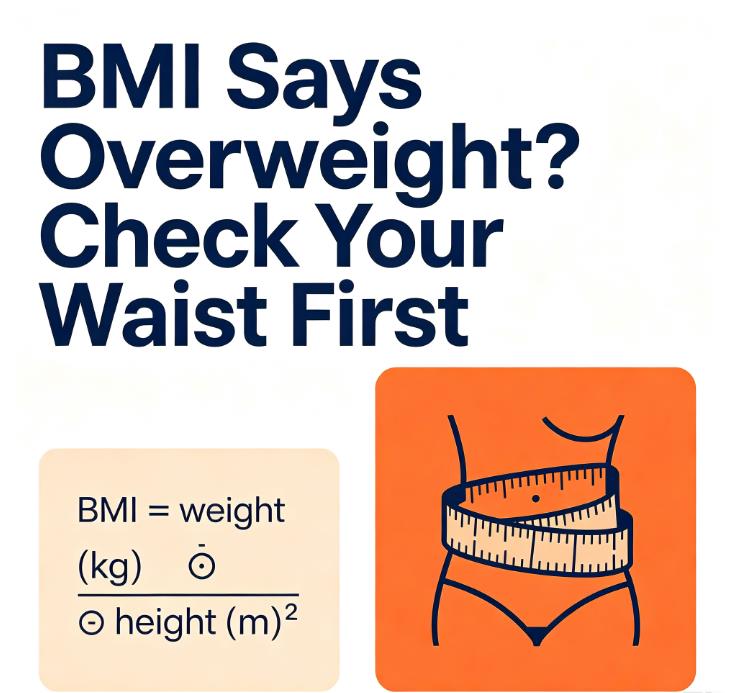
Step 3: Measure your waist at your navel — not your belt line. The NIH states women over 35 inches and men over 40 inches face higher health risks, even with a normal BMI.
Step 4: Adjust for context. Athlete? Over 65? Different rules apply.
Bottom line: If your waist is under the risk threshold, BMI matters less than how you move, sleep, and eat.
For body composition beyond the scale, use our body fat calculator.
Frequently Asked Questions
My doctor says my BMI is 26. Should I be worried?
Not necessarily. If you're active, your waist is under 35/40 inches, and your labs are normal, BMI alone doesn't define your health. Most U.S. primary care visits use it as a first screen, then look deeper.
I lift 5 days a week. Why does BMI say I'm overweight?
Because BMI is blind to muscle. Muscle packs more pounds per square inch. The number is misleading you, even though the math itself is correct.
I'm 68 and my BMI is 27. Is that bad?
Probably not. A slightly higher BMI in older adults can be protective. Focus on staying strong and independent rather than chasing 22.
My BMI is 24.5 but my waist is 38 inches. Which wins?
Your waist. Abdominal fat is a stronger health signal than BMI. Trust the tape measure.
Is BMI different for Asian adults?
Yes. The WHO sets lower BMI cutoffs and stricter waist thresholds. Use our adjusted calculator to get your real category.
Sources
This article is for informational purposes only. It does not replace professional medical advice. Always consult a qualified provider. The BMI Calculator Blog Team maintains editorial independence.