Article Summary: Calorie deficit meals keep you full at 400–500 cal per meal with 25–35g protein. Real food templates, a 7-day plan, and the #1 mistake to avoid.
What a calorie deficit meal actually is (and what it is not)
A calorie deficit meal helps you eat fewer calories than your body burns over the whole day. That is it. You do not need lettuce wraps for every meal.
The CDC recommends losing 1 to 2 pounds (0.45–0.9 kg) per week. That requires a daily deficit of 300 to 500 calories below your maintenance level.
Example: A moderately active woman who maintains at 2,000 calories/day targets 1,500–1,700. A moderately active man maintaining at 2,600 targets 2,100–2,300.
But here is what most people get wrong: They think "deficit" means eating tiny portions of bland food. The real trick is not eating less food — it is eating food that fills more space on your plate for fewer calories. Vegetables, lean protein, and fiber are your tools.
Not sure where your maintenance calories start? Use an online BMI calculator to get your baseline, then pair it with a calorie calculator to set your personal deficit target.
The three non-negotiable rules for every deficit meal
Rule 1 – Protein anchors every meal. The Academy of Nutrition and Dietetics states protein preserves muscle during weight loss and has the highest satiety effect. Aim for 25–35 grams per meal. That is roughly 4 oz (113 g) chicken breast, a can of tuna, 1 cup (225 g) cottage cheese, or a scoop of protein powder.
Rule 2 – Fiber fills the rest of your plate. WHO recommends at least 25g of dietary fiber daily. A cup (90 g) of broccoli has 31 calories; a cup of cooked lentils (200 g) delivers 15g fiber for 230 calories. Fiber slows digestion and keeps you full between meals.
Rule 3 – Fat makes it taste like actual food. The USDA suggests 20–35% of daily calories from fat. A tablespoon of olive oil (119 cal), a quarter of an avocado (80 cal), or a small handful of almonds (160 cal/oz) adds satiety and flavor. Dry chicken breast and plain steamed vegetables are not sustainable.
Visual reference: A portion of lean meat about the size and thickness of your palm provides roughly 20–25g protein. Double that for your 35g target.
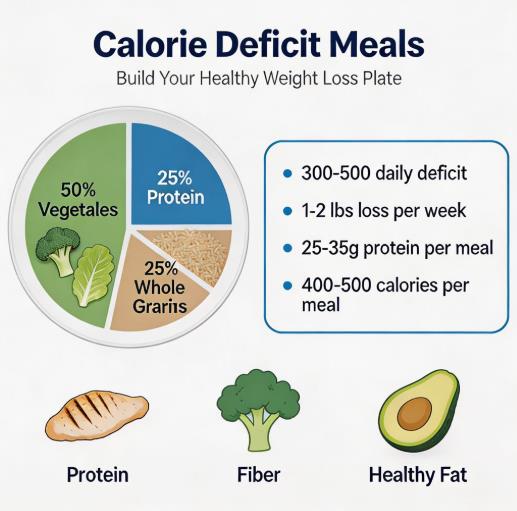
Calorie deficit meals that actually taste good: breakfast (300–450 cal)
Greek yogurt power bowl – 380 cal
¾ cup (170 g) plain nonfat Greek yogurt (100 cal, 18g protein), ½ cup (75 g) mixed berries (40 cal), 1 tbsp chia seeds (60 cal, 5g fiber), 1 tbsp sliced almonds (50 cal). Pro tip: Mix yogurt and chia seeds the night before — by morning it becomes a pudding-like texture.
Egg & vegetable scramble – 350 cal
2 large eggs (140 cal, 12g protein) scrambled with 1 cup (30 g) spinach, ½ cup (70 g) diced bell peppers, ¼ cup (28 g) reduced-fat cheese (80 cal). Serve with 1 slice whole-grain toast (80 cal).
Overnight oats with protein – 400 cal
½ cup (40 g) rolled oats (150 cal), ½ cup (120 ml) unsweetened almond milk (15 cal), ½ scoop vanilla protein powder (60 cal, 12g protein), 1 tbsp peanut butter (95 cal). Top with half a banana (50 cal).
Lunches that do not put you to sleep (400–500 cal)
Grilled chicken salad – 480 cal
4 oz (113 g) grilled chicken breast (180 cal, 35g protein), 3 cups (85 g) mixed greens (25 cal), ½ cup cherry tomatoes, ¼ avocado (80 cal), 2 tbsp vinaigrette (120 cal).
Tuna & white bean bowl – 420 cal
1 can (5 oz/142 g) tuna in water (120 cal, 26g protein), ½ cup (130 g) canned white beans (150 cal, 7g fiber), 1 cup arugula, lemon juice, 1 tsp olive oil (40 cal). Ready in 3 minutes.
Turkey & hummus wrap – 450 cal
1 whole-wheat tortilla (130 cal), 3 oz (85 g) sliced turkey breast (90 cal, 18g protein), 2 tbsp hummus (70 cal), cucumber and lettuce.
Fast-food hack: Grilled chicken sandwich (320 cal) plus a side salad with light Italian dressing (80 cal) = a 400-calorie deficit-friendly lunch.
Dinners that feel normal (450–550 cal)
Sheet pan salmon & vegetables – 500 cal
4 oz (113 g) salmon fillet (280 cal, 25g protein), 1 cup (90 g) broccoli (31 cal), 1 cup (200 g) cubed sweet potato (114 cal). Toss with 1 tsp olive oil (40 cal). Roast at 400°F (200°C) for 18–20 minutes. Meal prep: double the veggies for tomorrow's lunch.
Chicken stir-fry with cauliflower rice – 430 cal
4 oz (113 g) chicken breast (180 cal, 35g protein), 2 cups (200 g) stir-fry vegetables (50 cal), 1 tbsp soy sauce (10 cal), 1 tsp sesame oil (40 cal). Serve over 1½ cups (160 g) riced cauliflower (40 cal).
Turkey chili – 450 cal per bowl
Makes 4 servings: 1 lb (450 g) lean ground turkey, 1 can kidney beans, 1 can diced tomatoes, chili seasoning. Per serving: 450 cal, 35g protein, 12g fiber. Freezes beautifully.
Quick shortcut: Rotisserie chicken (3 oz = 140 cal) + bagged broccoli + microwaveable sweet potato = a 450-cal dinner in 8 minutes.
Snacks that close the gap (100–150 cal)
Hard-boiled egg + small apple: 150 cal, 7g protein
½ cup (113 g) 1% cottage cheese + cucumber slices: 90 cal, 14g protein
1 tbsp peanut butter on celery: 105 cal, 4g protein
String cheese (part-skim): 80 cal, 7g protein
For more ideas, see our guide on low calorie snacks under 150 calories.
Common myths vs. evidence: a cheat sheet
| Myth | Evidence-based truth |
|---|---|
| Carbs are bad for a deficit | WHO says carbs should be 45–65% of daily energy. A sweet potato (114 cal) or ½ cup quinoa (111 cal) fits easily. Excess calories matter, not carbs alone. |
| You must eat 6 small meals a day | Meal frequency does not change metabolism. Three 400–500 cal meals + one snack works fine. Do what fits your schedule. |
| Eating after 8 PM causes weight gain | Weight gain depends on total daily calories, not timing. A 150-calorie snack at 10 PM will not break your deficit. |
| All "diet foods" are healthy | Many low-calorie frozen meals are high in sodium and low in protein. Read labels. Real food is almost always better. |
Your 7-day calorie deficit meal starter plan
Daily Structure: Breakfast (~380 cal) + Lunch (~450 cal) + Afternoon Snack (~120 cal) + Dinner (~500 cal) + Optional Evening Snack (~100 cal)
Women's Daily Total: ~1,550 calories
Men's Daily Total: ~2,050 calories (add 200 cal to lunch or dinner)
Simplified Tracking: Focus only on hitting 25–35g protein per meal and filling half your plate with non-starchy vegetables
Do not obsess over every calorie for the first week. Just hit the protein and vegetable targets.
Special note for Asian populations
If you are of Asian descent, your body may store fat at a lower BMI and calorie intake than white populations. The WHO suggests a lower healthy BMI range (18.5–22.9) for Asians. South Asian adults may need an even smaller deficit (150–250 calories) due to higher insulin resistance and visceral fat accumulation at lower BMIs. Start with a smaller cut and prioritize protein and fiber even more. An Asian BMI calculator can give you a more accurate baseline.
What if I am still hungry after a 500-calorie meal?
Follow these two steps in order:
Add more vegetables first. A cup of broccoli (31 cal) or two cups of mixed greens (15 cal) adds bulk without breaking your deficit.
Then check your protein. Meals under 20g protein leave people hungry within 2–3 hours. Bump it to 30–35g.
If you are genuinely hungry all day, your deficit may be too large. Increase by 100–150 calories for a week and see how you feel. Weight loss should not feel like starvation.
Important safety note: do not overdo the deficit
Never go below 1,200 calories per day for women or 1,500 calories per day for men without medical supervision. Extreme deficits can cause muscle loss, nutrient deficiencies, and metabolic damage. The safe range is 300–500 below maintenance, not 1,000+ below.
Final thought: consistency beats perfection
Chasing the perfect diet is the biggest enemy of consistency. What actually works is a "good enough" plan you can stick with.
Start with one swap today: replace your mid-afternoon soda or latte with water or black coffee. That is a 150–250 calorie deficit without changing a single meal.
Frequently Asked Questions About Calorie Deficit Meals
How many calories should my deficit meals be to lose weight?
Most women target 1,500–1,800 total daily calories, split into 3 meals of 400–500 each plus one 100–150 snack. Men target 1,800–2,200. Use a calorie calculator to find your maintenance number, then subtract 300–500.
Can I eat carbs and still be in a deficit?
Absolutely. The WHO recommends 45–65% of calories from carbs. The problem is not carbs — it is liquid calories (soda, sweet tea, lattes) and oversized portions of refined grains. A cup of quinoa (222 cal) or a sweet potato (114 cal) fits fine.
Do I need to eat the same deficit meals every day?
Absolutely not — that leads to burnout. Pick 3-4 go-to meals for each meal time and rotate them. That way you do not have to think about it every day, but you still get variety. For more structured planning, see our guide on calorie control based on BMI.
What if I eat out a lot? Any restaurant hacks?
Yes. At Chipotle: burrito bowl (no tortilla) with double chicken, fajita veggies, salsa, lettuce. Skip cheese and sour cream (save ~200 cal). At Subway: 6-inch turkey on wheat with all veggies and mustard (no mayo) is ~350 cal. At a diner: order an omelet with vegetables and ask for egg whites only (saves ~100 cal).
How fast will I see results?
At a 300–500 daily deficit, expect 0.5–1 pound (0.2–0.45 kg) of fat loss per week. The CDC confirms that people who lose weight gradually (1–2 lbs/week) are more successful at keeping it off.
Should I skip breakfast to save calories?
Only if you are not hungry in the morning. Skipping breakfast does not boost metabolism. If it makes you overeat at lunch or snack more at night, do not do it. The best deficit meal schedule is the one you can stick with.
Content Integrity Review: This article has been reviewed for alignment with CDC, USDA, WHO, and AND guidelines on calorie deficit, protein intake, and safe weight loss. Individual health decisions should always be made with a qualified healthcare provider.
Developed using: CDC healthy weight loss guidelines, USDA Dietary Guidelines for Americans (2025–2030), WHO healthy diet recommendations, and AND evidence-based practice guidelines.
References & Sources
WHO: Healthy Diet — energy balance and macronutrient guidelines
NIH/NIDDK: Body Weight Planner — personalized calorie deficit estimation
BMI Calculator Blog. This content is provided for educational and informational purposes only. We encourage sharing with proper attribution to our site. Unauthorized commercial use is prohibited. Medical Disclaimer: This content does not replace professional medical advice, diagnosis, or treatment. Always seek the advice of a qualified physician or other licensed health provider before starting any weight loss plan, especially if you have pre-existing health conditions or concerns.