At a Glance: Overweight is BMI 25–29.9; obesity starts at 30. About 72% of U.S. adults are above a healthy BMI, and health risks jump sharply past the BMI 30 line — but BMI is a screening tool, not a diagnosis. Pair it with waist measurement and body composition data.
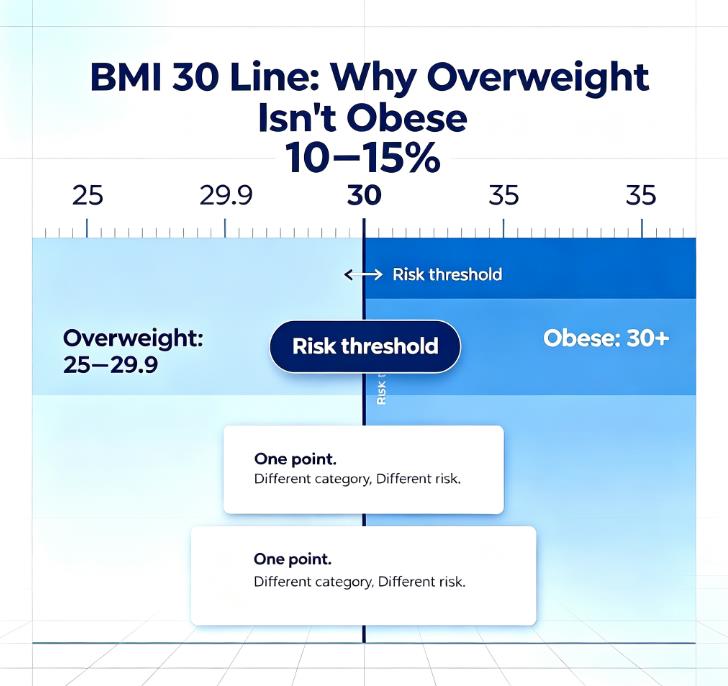
That one-point difference between 29.9 and 30 moves you from "warning" to "alarm" in the eyes of major health organizations. Here's what that line really means for your health.
Overweight vs. Obesity: What's the Difference?
Overweight is a BMI of 25 to 29.9. Obesity is a BMI of 30 or higher. These are the official categories from the CDC and WHO.
The formula is weight divided by height squared. That number places you in one of four buckets:
Underweight: Below 18.5
Healthy weight: 18.5 to 24.9
Overweight: 25 to 29.9
Obesity: 30 or greater
Obesity is further broken into three classes: Class 1 (BMI 30 to less than 35), Class 2 (35 to less than 40), and Class 3 or severe obesity (40 or greater).
The WHO classifies obesity as a chronic disease. Overweight is the warning sign. Obesity is when that warning requires ongoing management. Check your number in seconds with our Adult BMI Calculator.
By the Numbers: How Common Are They?
According to CDC National Health and Nutrition Examination Survey data (2021–2023):
Overweight: 31.7% of U.S. adults
Obesity: 40.3% of U.S. adults
Severe obesity: 9.7%
Together, about 72% of U.S. adults are above the healthy BMI range. Obesity peaks in adults ages 40–59 at 46.4%.
Why the BMI 30 Line Matters
This line isn't pulled out of thin air. Research shows health risks climb steeply once you cross from overweight into obesity. At BMI 30+, risk rises for type 2 diabetes, high blood pressure, heart disease, stroke, certain cancers, sleep apnea, and osteoarthritis.
Here's the encouraging part: even a modest 5% weight loss — about 10 lbs for a 200-lb person — can significantly lower blood sugar and heart risk, according to clinical obesity guidelines. See what a healthy window looks like for your height with our healthy weight range tool.
Why BMI Isn't the Whole Story
The CDC is clear: BMI is a screening measure, not a definitive health measure. Here's what it misses:
A powerlifter at BMI 28 may have 12% body fat. The formula counts muscle and fat equally. Belly fat drives risk too — women over 35 inches and men over 40 inches face higher danger regardless of BMI, as the NIH/NHLBI confirms. Age matters as well: a 65-year-old and 25-year-old share the same chart, but older adults need more reserves — research supports a BMI window of 21–27 for adults over 65, not the standard 18.5–24.9. And ethnicity shifts the curve: the WHO sets lower thresholds for Asian adults, with risk starting at BMI 23, not 25.
Our Asian BMI calculator applies these adjusted cutoffs. For body composition beyond BMI, try our body fat calculator.
In our 2025 calculator sessions, we see this daily: about 1 in 4 people with a "normal" BMI have a risky waist. Meanwhile, 1 in 3 users labeled overweight have healthy waists. That's why we always tell users to measure their waist — it catches what BMI misses.
How to Use This Information
Start with your BMI. Note your category. Then measure your waist at your navel — over the NIH limits (35 inches for women, 40 for men) is your real priority. Factor in your context: active? Over 65? Of Asian descent? Different ranges apply. And keep the focus on habits. Blood pressure and energy matter more than the scale.
Common Misconceptions
A common misconception is that overweight and obesity are the same thing. They're not — different categories, different risk levels. BMI 30 is a clinical threshold for chronic disease. Another frequent misunderstanding: that 29.9 and 30 are basically identical. Population studies show a sharp risk jump at 30. That one point matters.
Many also assume BMI tells the whole story. BMI only gives a quick snapshot — it cannot account for muscle mass, where fat accumulates, or your lab test results. And perhaps most importantly, being "overweight" by BMI doesn't automatically mean you're unhealthy. Many active people land at BMI 27 with great health markers. Context matters.
Frequently Asked Questions
What is the difference between overweight and obesity?
Overweight is BMI 25–29.9. Obesity is BMI 30+. The WHO defines obesity as a chronic disease with higher risks for diabetes, heart disease, and other conditions.
Is a BMI of 29.9 really that different from 30?
Clinically, yes. Large population studies show health risks rise sharply at 30. It's the line where excess weight starts to drive chronic disease more aggressively.
Can you be overweight and still be healthy?
Often, yes. If you're active, your waist is under 35/40 inches, and your labs are normal, BMI 25–29 is usually not a concern. Fitness matters more than the label.
Is obesity different for men and women?
The formula is the same, but women naturally carry more body fat. Waist size and body fat percentage give a more complete picture than BMI alone.
Does BMI change for older adults?
The chart doesn't, but your body does. Research supports a BMI of 21–27 as a protective range for adults over 65, not the standard 18.5–24.9.
Sources
This article is for informational and educational purposes only. It does not constitute medical advice. Consider discussing your results with a qualified professional. Individual results vary. The BMI Calculator Blog Team maintains editorial independence.