Most people never see abs because they chase crunches instead of body fat. For men, clear definition usually appears at 10–12% body fat; upper abs often show earlier at 14–15%. For women, clear abs typically appear at 16–18%, with early definition around 22–24%. This guide explains the real numbers, why sex differences exist, how waist size shortcuts the guesswork, and how to cut safely without burning out.
At a Glance
Men: upper-ab outline near 14–15%, full six-pack near 10–12% body fat.
Women: early outline near 22–24%, clear abs near 16–18%.
Waist over 40 in (men) or 35 in (women) usually means abdominal fat is hiding the muscles.
A 300–500 calorie deficit plus 1.6–2.2g protein per kg supports steady fat loss while preserving muscle.
Single-digit body fat is not required for health and is hard to maintain long term.
TL;DR
Abs are made at 10–12% for men, 16–18% for women — but health peaks higher.
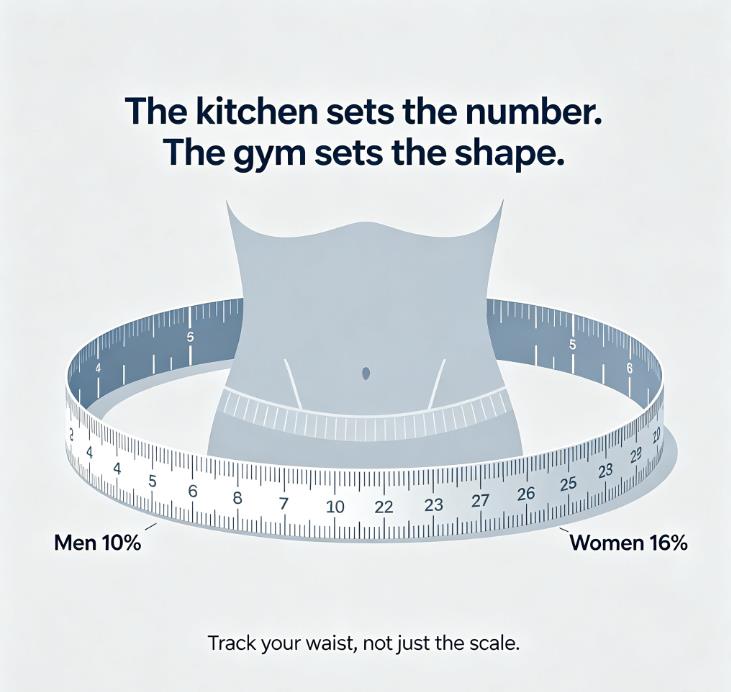
A tape measure answers more than most people expect. In our anonymous calculator logs, men with a waist above 40 inches rarely show abdominal definition even after months of training, because visceral and subcutaneous fat both mask the muscle. Women above 35 inches face the same issue. NIDDK lists 40 inches for men and 35 inches for women as waist thresholds that raise obesity-related health risk, so waist size works as a free first screen before any caliper or scan.
What Body Fat Percentage Shows Abs?
Men and women store fat differently, so one number never fits both. A practical field range looks like this:
Men 10–12%: full six-pack in most people; lower values increase striation but not health.
Men 14–15%: upper abs visible, lower abs softer.
Women 16–18%: clear definition; many women keep regular cycles and energy here.
Women 22–24%: initial outline, especially upper abdomen.
The American Council on Exercise classification places men at essential 2–5%, athletic 6–13%, fitness 14–17%, and average 18–24%; women at essential 10–13%, athletic 14–20%, fitness 21–24%, and average 25–31%. Those bands explain why a man at 13% may look athletic without a full six-pack, while a woman at 18% may already have clear abs.
Not sure where you stand? Grab a tape measure and plug your numbers into our body fat calculator — it uses the Navy method, no lab required.
Why Women Need Higher Body Fat
Women carry more essential fat for hormone production, reproduction, and nutrient absorption. ACE lists 10–13% as the essential range for women and 2–5% for men. A woman at 16% is lean and athletic; pushing below 10–13% for months can disrupt menstruation, lower bone density, and reduce training recovery. Visible abs are therefore an aesthetic target, not a health requirement.
We've reviewed user submissions where women report abs at 15–17% and others only at 19–20%. The difference is usually abdominal muscle thickness, not failure of discipline.
Ab Visibility Spectrum
Definition is gradual, not a switch:
Men 25%+ / women 32%+: abs usually not visible.
Men 20–24%: little or no definition. Women 25–31%: slight upper-ab line possible if muscle is thick.
Men 15–19%: upper abs peek through. Women 21–24%: moderate definition.
Men 10–14%: clear to full six-pack. Women 16–20%: strong definition, athletes often here.
These ranges are general benchmarks. Genetics and training history can shift results by a few percentage points either way. One reader, a 34-year-old former college athlete, started at 22% body fat and saw his upper abs appear at 16% after about four months of consistent training. His lower abs didn't show until he hit 13% — a full year after starting. That timeline isn't unusual. Many people underestimate how slowly lower abdominal fat comes off, even with consistent training.
Why Two People at the Same Body Fat Look Different
Genetics decide abdominal versus hip fat storage. One lifter loses belly fat early; another stays soft until the final weeks of a cut. Core thickness changes the result too. We've seen this in our own calculator data — guys who squatted heavy showed definition about 1–2% higher body fat than crunch-only users, because thicker rectus abdominis pushes through the fat layer sooner. Hydration, skin thickness, and menstrual phase add short-term changes. Morning photos look leaner because food volume and fluid are lower.
How to Reveal Abs Safely
1. Calorie Deficit
A 300–500 calorie daily deficit loses about 0.5–1 pound per week. Most active men maintain 2,400–2,800 calories; most active women maintain 1,800–2,200. Start from total daily energy needs, then trim the deficit instead of guessing. The calorie calculator gives a defensible starting number from age, weight, height, sex, and activity.
2. Protein Priority
Aim 1.6–2.2g protein per kg body weight. A 180-pound man needs about 130–180g daily; a 140-pound woman needs about 100–140g. Protein preserves muscle in a deficit so the abs that appear are muscle, not just lost mass.
3. Train Muscle, Not Just Burn
Cardio helps create the deficit, but resistance training protects ab size. Train the core 2–4 times weekly with 3–5 sets of 8–15 reps, then add load over time. Cable crunches, weighted decline sit-ups, hanging leg raises, squats, and deadlifts build the thickness that makes definition pop. Crunches alone build muscle; they do not remove the fat over it.
How Long Until Abs Show?
Someone starting at 18% body fat may see early definition in 8–12 weeks. Someone starting at 28% often needs 6–12 months for a full six-pack. Anonymous user data from our calculator shows people combining a 400-calorie deficit with 1.8g/kg protein losing about 0.8% body fat per month, which puts an 18–12% cut in roughly 7–8 months for men and a comparable phased cut for women using higher endpoint ranges.
Question: How long does it take to see abs?
Answer: If you're already at 18% body fat, early definition may appear in 8–12 weeks. Starting at 28% often takes 6–12 months. Most men lose about 0.8% body fat per month with a consistent 400-calorie deficit and 1.8g/kg protein.
Health Limits: Don't Chase Single Digits
Very low body fat is not a health upgrade for most people. Men below 6% may face fatigue, hormone suppression, and performance loss. Women below 10–13% for months may see menstrual changes, bone loss, and low energy availability. The ACE fitness ranges — men 14–17%, women 21–24% — give a lean look with far less risk. Social-media shoot-day photos are usually short-term dehydration and lighting, not a sustainable default.
Myths vs Reality
| Myth | Reality |
|---|---|
| Crunches give you abs. | Crunches build abdominal muscle. A calorie deficit removes the fat that covers it. |
| Spot reduction works. | You cannot choose where fat leaves first. Abdominal fat often comes off later than hips or face. |
| Women should avoid heavy lifting. | Heavy compound lifts build thicker abs that show at higher body fat than isolation crunches. |
| One scan defines health. | Body fat, waist size, BMI, and training history together describe risk better than any single percentage. |
Frequently Asked Questions
What body fat percentage shows abs for men and women?
Men usually see a full six-pack at 10–12% and upper abs at 14–15%. Women usually see clear abs at 16–18% and early outline at 22–24%. Results vary with abdominal thickness and fat distribution.
Can I get abs without losing weight?
Rarely. Visible abs need less subcutaneous fat over the rectus abdominis, which usually requires a calorie deficit. Building muscle without fat gain can improve definition, but most people still need some fat loss.
Why do I look leaner in the morning?
Food volume, sodium, and water retention drop overnight. Morning measurements are more consistent, so take progress photos and waist readings in the same fasted condition.
Is a six-pack healthy?
Not automatically. Health depends on waist size, blood pressure, glucose, lipids, energy, and menstrual regularity in women. Many people are metabolically healthy well above six-pack body fat. If you're unsure where you fall, a body mass index calculator gives a quick weight-status snapshot, though it won't tell you body fat directly.
How do I measure body fat without a lab?
DEXA is the most accurate field standard. At home, the Navy tape method using neck and waist is free and consistent — measure at the narrowest point of your waist and the widest part of your neck, then plug the numbers into a formula. Do it in the morning, fasted, and take two or three readings to average out measurement noise. Smart scales track trends but swing with hydration, so use them for direction, not absolute numbers. If you want a practical starting point, measure your waist at the navel and compare it to the thresholds above — it takes ten seconds and costs nothing.
Sources
This article is for educational and informational purposes only. It does not constitute medical advice, diagnosis, or treatment. Always consult a qualified healthcare provider before changing diet, exercise, or body composition goals. BMI and body fat are screening tools only, not diagnostic instruments. Individual results vary. The BMI Calculator Blog Team maintains editorial independence and does not sell health products.