Quick Summary: Yes — your BMI can rise during menopause even if the scale doesn’t move. BMI is just weight divided by height. If you lose muscle and gain fat at the same time, your weight stays stable while your body composition shifts. Falling estrogen drives this change — it redirects fat storage toward your abdomen and accelerates muscle loss.
BMI can rise without weight gain because muscle loss offsets fat gain on the scale.
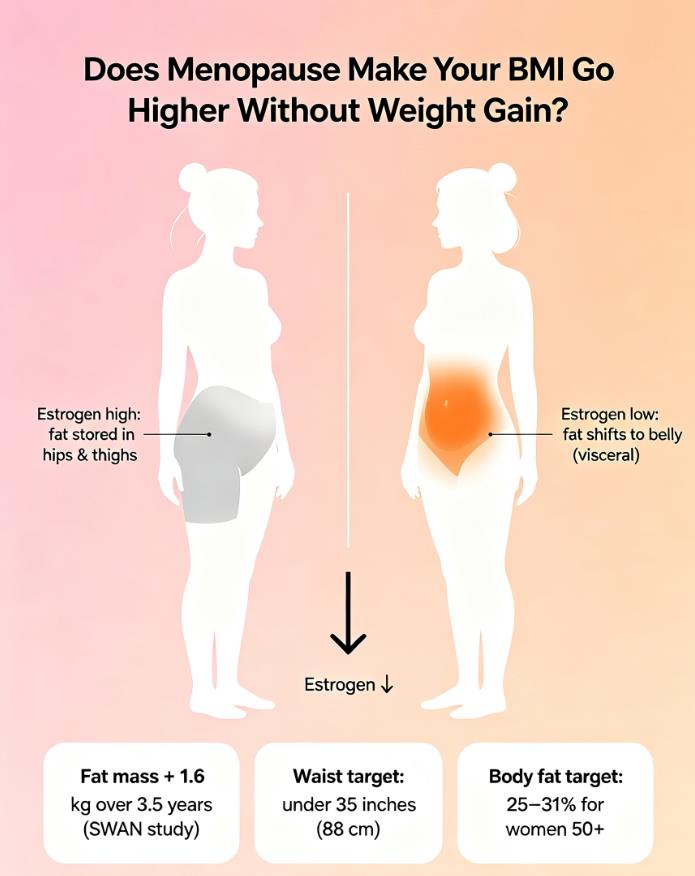
Estrogen decline moves fat storage to the abdomen (visceral fat).
Women gain about 2.1 kg over five years during the transition, even without habit changes.
Waist circumference is a better risk signal than BMI at this stage.
Strength training and protein are the most direct counters to this shift.
Why BMI Can Rise Without Weight Gain
A 52-year-old woman steps on the scale. Same weight as last year. Same BMI. But her jeans fit differently, and her waist is thicker. She hasn’t changed her eating or exercise habits.
What happened? Her body swapped muscle for fat. Muscle is denser than fat — it takes up less space. When you lose a pound of muscle and gain a pound of fat, the scale reads the same. But your body composition has shifted in a direction that raises metabolic risk.
CDC data confirms this common shift. Many women see body changes across perimenopause and menopause, triggered by dropping estrogen. But the more important change isn’t weight — it’s where the weight sits and what it’s made of.
The Estrogen Connection: Why Fat Moves to Your Belly
Before menopause, estrogen encourages fat storage around the hips and thighs. After menopause, that signal fades. Fat migrates to the abdomen. Research shows that estrogen decline directly contributes to accelerated visceral fat storage — the deep abdominal fat packed around your organs.
This isn’t just about appearance. Visceral fat is metabolically active. It releases inflammatory compounds linked to insulin resistance, abnormal cholesterol, and cardiovascular risk. A woman with a BMI of 23 and a thick waist may face higher risk than a woman with a BMI of 26 and a narrow waist.
What the Research Shows
Research from the Study of Women’s Health Across the Nation (SWAN) tracked body composition through the menopausal transition. Fat mass increased by an average of 1.6 kg (about 3.5 lbs) over 3.5 years, while lean mass declined. The rate of fat gain accelerated around the final menstrual period.
Other data from SWAN found that women aged 46–57 gain an average of 2.1 kg (4.6 lbs) over five years during this transition. That’s not dramatic — but it’s consistent, and it compounds over time.
The key insight: BMI may stay flat or rise slightly while body fat percentage climbs and muscle mass falls. Two women at the same BMI can have completely different health profiles.
Why the Scale Misses This Shift
BMI only reads height and weight. It cannot separate muscle from fat, nor track where fat accumulates. These limitations hit hardest during menopause.
A 2019 study in Menopause tracked women through the transition and found significant increases in abdominal fat alongside declines in lean mass — even among women whose weight remained stable. The scale stayed the same. The body composition didn’t.
Waist circumference reveals what BMI misses. For women, a waist over 35 inches (88 cm) signals elevated metabolic risk regardless of what the scale says. A tape measure tells you more than a BMI chart ever could.
What to Track Instead of Just BMI
| Metric | Why It Matters | Target |
|---|---|---|
| Waist circumference | Detects visceral fat that BMI misses | Under 35 inches (88 cm) |
| Body fat percentage | Tracks composition changes | 25–31% for women 50+ |
| Grip strength | Marker of muscle preservation | Track trend, not single reading |
A Gender Adjusted BMI Calculator gives you a baseline. But pair it with a body fat calculator and a tape measure. The three numbers together tell a more complete story than BMI alone.
What You Can Do About It
The hormonal changes are not reversible. But the muscle loss and fat gain are not inevitable either. Two evidence-backed strategies stand out:
Resistance training 2–3 times per week. Preserves lean muscle and supports bone density. Even bodyweight exercises count — the goal is signaling your body to hold onto muscle.
Protein at every meal. Aim for 1.2–1.6 grams per kilogram of body weight daily. Spread it across three to four meals. Muscle protein synthesis responds better to consistent intake than one large dose.
Walking matters too. Accumulating 7,000–8,000 steps per day is tied to lower all-cause mortality in older women. You don’t need to complete all steps in one single session; split them up across morning, noon and evening.
For a deeper look at body composition changes during this stage, see our guide on body composition changes for women after 50.
Frequently Asked Questions
Can menopause cause BMI to rise without weight gain?
Yes. If you lose muscle and gain fat at the same rate, your weight — and therefore your BMI — stays the same. But your body composition changes, and that shift carries health implications. Waist circumference and body fat percentage catch what BMI misses.
How much fat do women typically gain during menopause?
Research from SWAN shows an average gain of about 1.6 kg (3.5 lbs) of fat mass over 3.5 years, with accelerated gains around the final menstrual period. Some studies report up to 2.1 kg (4.6 lbs) over five years.
Is BMI still useful after menopause?
BMI remains a useful screening baseline, but its limitations become more pronounced. It can’t detect muscle loss or visceral fat gain. Pair it with waist circumference and body fat percentage for a more accurate picture.
What waist size signals risk after menopause?
For women, a waist circumference over 35 inches (88 cm) signals elevated metabolic risk, regardless of BMI. Measure at navel level, after exhaling normally.
Can strength training stop the body composition shift?
Strength training doesn’t stop the hormonal changes, but it directly counters muscle loss and helps preserve metabolic rate. Two to three sessions per week is the evidence-backed minimum.
Does hormone replacement therapy prevent BMI changes?
HRT can help with some symptoms and may slightly influence fat distribution, but it’s not a weight management tool. The primary drivers of body composition change — aging and declining estrogen — continue regardless.
Sources
This article is for informational and educational purposes only. It does not constitute medical advice, diagnosis, or treatment. Always consult a qualified healthcare provider regarding your individual health and body composition goals. Individual results will vary. The BMI Calculator Blog Team maintains editorial independence and does not sell health products.